Why the Employees Thriving With AI Aren't the Tech Experts
What Singapore's AI adoption gap reveals about who actually wins with AI at work.
TO EMPLOYEES
Kenneth Lam
2/12/20264 min read
Two-thirds of Singapore's SMEs use AI, yet only 12% fully integrated it, according to the latest DBS Business Pulse Check Survey (December 2025–January 2026). This gap explains something important: employees succeeding with AI aren't technical experts. They're domain experts who learned one tool well.
Anthropic's Economic Index Report (January 2026) analyzed millions of real work conversations and found patterns that contradict the panic narrative. The highest success rates, biggest gains—they're people using AI to do existing jobs better, not those who became AI specialists. Here's what the data actually shows about who wins with AI.
The Data on Who's Actually Winning
Claude is used most on software debugging, coding, and education—domains where users already have deep expertise. The productivity numbers prove it: according to Anthropic's Economic Index, college-level tasks see 12x speedup versus 9x for high school-level work. Your expertise creates better leverage. This is how AI works—it's most powerful when guided by someone who understands the problem deeply.
But here's where it gets strategic. Claude succeeds about 66% of the time on complex tasks, versus 70% on simple ones. This matters because it means the most valuable work in your domain—work requiring your judgment—stays dependent on your expertise. AI isn't replacing your thinking. It's accelerating it, but you're still essential for the 34% of times it gets it wrong, misses critical context, or needs expert validation.
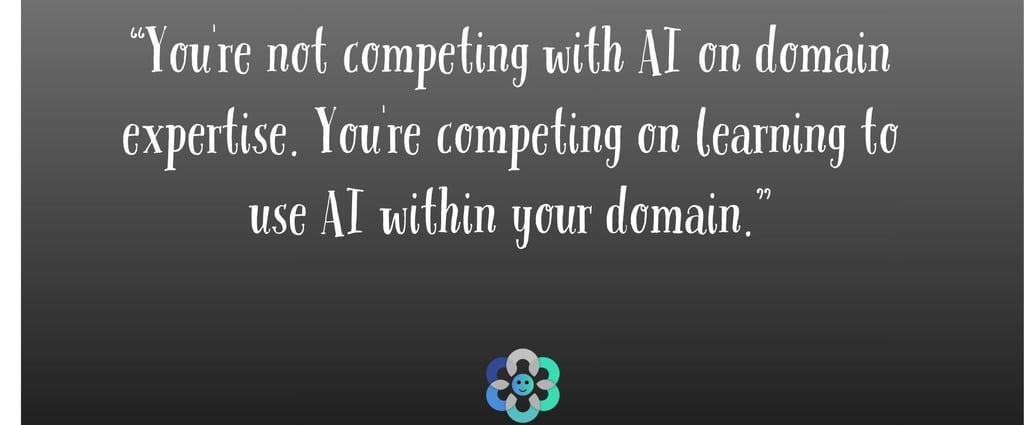
The central insight: you're not competing with AI on domain expertise. You're competing on learning to use AI within your domain. In Singapore, the businesses realizing the biggest gains—averaging 52% cost savings according to the IMDA Singapore Digital Economy Report 2025—are using AI consistently in three areas: IT support, customer service, and finance & accounting.
Notice something important: these aren't technical specialists winning. They're domain experts who learned to use AI as a tool. The financial analyst who knows her industry and uses Claude for scenario testing beats the analyst who becomes a prompt expert without financial knowledge. Every time. Your expertise is the foundation. AI is the accelerant.
What the Geographic Data Tells You
Adoption follows workforce composition and economic development, not resistance. According to the DBS Business Pulse Check Survey, Singapore shows this clearly: information and communications, plus manufacturing sectors lead in AI adoption. Wholesale and trade lag. The difference isn't that traders resist technology. It's that AI capabilities haven't yet aligned with their work patterns. That matters because it means your sector's timing isn't about your readiness—it's about when the tools become relevant.
This timing advantage benefits you directly. The IMDA Singapore Digital Economy Report 2025 shows that SME AI adoption tripled in one year—from 4.2% in 2023 to 14.5% in 2024. If your sector is lagging, you have breathing room to learn strategically rather than under crisis conditions. Within the US, Anthropic's data suggests regional parity could arrive within 2-5 years. Early adopters' head start will flatten out.
Translation: you don't need to panic that other sectors are racing ahead. You need to stay alert for when AI becomes relevant to your work, then learn intentionally. That's how you build domain expertise that compounds in value rather than learning AI skills that become obsolete.
What Actually Changes Your Career
The stakes are real. The most valuable work you do—work requiring your judgment and deep knowledge—isn't disappearing. But how it transforms depends on your choices.
Anthropic's research shows that some occupations upskill when AI handles routine work (real estate managers keep complex negotiations and stakeholder management), while others deskill (travel agents keep routine transactions). Your personal path depends entirely on your choices. A travel agent using AI to handle routine work so they can focus on complex, high-value itineraries upskills. One who resists might deskill. The difference isn't the technology. It's what you choose to do with the time AI frees up.
How to Actually Prepare
The data points to concrete actions worth taking now. In Singapore, this is especially actionable because you have direct support:
Stop treating AI as something you need to learn separately from your work. The people getting the biggest wins aren't learning abstract AI concepts. They're getting better at their jobs and finding simple tools to amplify that expertise. Your competitive advantage isn't "I understand how transformers work." It's "I understand my field, and I know how to use AI within it."
Expect to iterate. AI output requires human judgment. You're accelerating your thinking through partnership. Expect more feedback loops and refinement.
Find high-complexity work. Identify genuinely difficult tasks. According to the IMDA report, the highest-impact AI applications across Singapore's SMEs are in customer service, finance, and IT—so start there if your role touches these areas.
Leverage Singapore's support ecosystem. If your SME hasn't invested in AI yet, the government's CTO-as-a-Service provides free guidance and pre-approved solutions with grant support through the Productivity Solutions Grant (PSG). If your sector is lagging adoption, use that advantage: learn intentionally and thoroughly rather than under crisis pressure.
The Real Competition
Here's what all this data actually means: your domain expertise is becoming your competitive advantage in an AI world, not your liability. The employees thriving aren't the ones who pivoted to become AI experts. They're those who deepened their domain expertise while learning to use AI as a strategic tool.
The evidence is concrete. The 12x speedups on complex work are real productivity gains. The success rates show your judgment stays essential—AI isn't perfect. The geographic variation is real—change happens unevenly, giving you time to prepare intentionally.
You already have what you need to succeed. Your job knowledge isn't something to apologize for. It's the foundation everything else builds on.
Now use it well.
"The heart of the discerning acquires knowledge, for the ears of the wise seek it out"
Proverbs 18:15
Cultivating the Future of Work
Empowering businesses through human-centered AI.
© 2025. All rights reserved.