
When AI Can Do 80% of Your Job, What Makes You Irreplaceable?
Microsoft's research shows 40 jobs at high risk from AI. Corporate executives say AI hasn't affected their workforce. Both are true. Here's why that's a problem—and what you should do about it.
AI TRENDS
Kenneth Lam
2/24/20264 min read
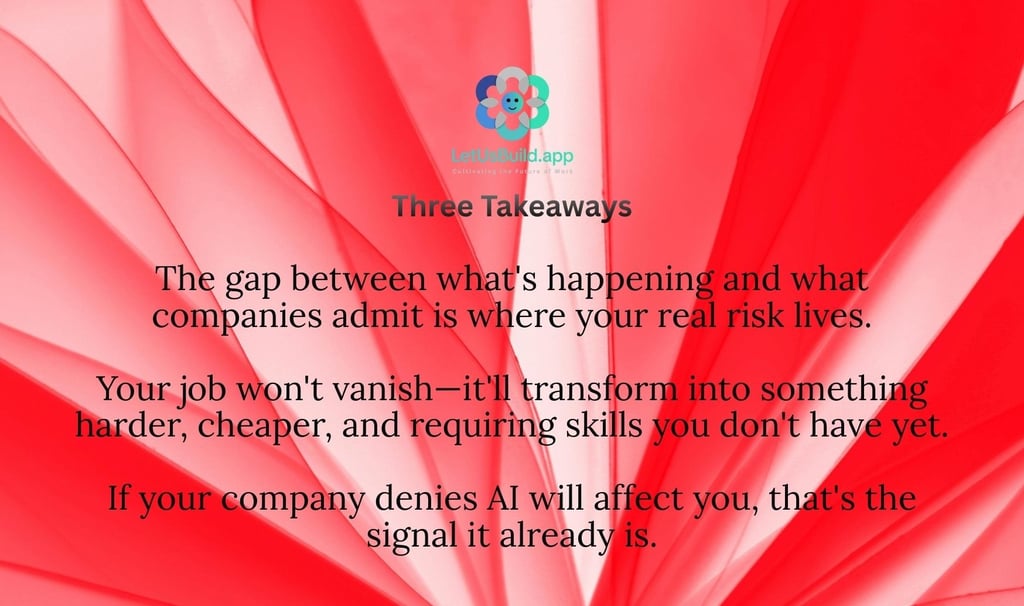
Breaking the paralysis between hype and reality
Joe Turner spent six figures as a freelance writer before generative AI arrived. Within two years, he'd lost 70% of his clients and £120,000 in income. "It's a betrayal," he told Sky News. "You've put your heart and soul into it for so long, and then you get replaced by a machine." His story isn't unique. It's the opening scene in a larger reckoning about which jobs AI is actually affecting—and which ones we're just anxious about.
One definitive study. Two irreconcilable narratives.
Last summer, Microsoft Research published findings based on 200,000 real conversations between workers and Copilot. The results seemed definitive: 40 job categories have significant AI overlap. Interpreters and translators top the list at 98% task alignment. Historians, writers, customer service representatives, and data scientists all face substantial exposure. The implication was clear—prepare for major workplace disruption.
Except here's what complicates the narrative: OpenAI's Sam Altman just confirmed that some companies are engaging in "AI washing"—blaming artificial intelligence for layoffs they would have made anyway. Meanwhile, nearly 90% of surveyed corporate executives reported that AI hasn't actually affected their workforce over the past three years. Yet Stanford research simultaneously shows early-career workers in high-exposure roles experiencing a 13% relative decline in employment. So which is it? Is AI a jobs crisis or corporate theatre?
The trap: both narratives are partially true, and that's the problem
The answer is both. This is the trap workers fall into. You can't wait for displacement to become undeniably obvious, because by then the early-career cohorts are already 13% smaller. You also can't trust corporate narratives that minimize the threat, because those same companies are quietly restructuring. You're stuck choosing between two unconvincing stories, while the actual transformation happens underneath the noise.
What Microsoft's study reveals isn't that these 40 jobs will vanish. It's that they were built on a foundation that's collapsing: the scarcity of information processing. A paralegal's value came from accessing legal research that was expensive and hard to obtain. A financial analyst synthesized market data that required expertise to interpret. A copywriter created marketing content that demanded specialized skill. All of these roles existed because information was a bottleneck.
Now it isn't. Information processing is abundant and nearly free. The job categories fall into six groups, each facing different timelines. Language and content roles—translators, writers, editors, journalists—face immediate pressure (1-2 years). Customer-facing information work—sales, customer service, travel agents, concierges—follows close behind. Data research and analysis, administrative processing, education, and technical work face medium-term transformation (2-5 years). But across all six groups, the pattern is identical: roles built on information scarcity are losing their primary economic justification.
The real distinction isn't job destruction—it's role redefinition
Here's what matters: the distinction between job replacement and job redefinition. Your employer might not eliminate the position. They'll just redefine it, shift the pay down, and require entirely new adjacent skills. The person who waits passively for their job to disappear misses the earlier warning sign—the gradual erosion of the role itself.
This is why corporate "AI washing" actually makes the situation more complicated, not easier. If your company claims AI won't affect you, you have no external validation that change is coming. You can't point to the headlines and say "I saw this coming." You have to trust your own assessment of whether your role's core value is being automated, regardless of what management says. You can't wait for the company to tell you it's time to transition.
Singapore's constraints accelerate the timeline
For Singapore specifically, the situation carries both protective factors and hidden urgency. Singapore organizations average S$18.9 million in spending per AI initiative, yet only 23% report achieving expected returns. In Singapore's regulated, high-cost, talent-constrained environment, AI becomes financially viable only when treated as a governed productivity engine, not a shortcut to workforce reduction. This regulatory framework and talent scarcity actually constrain reckless automation. But it also means companies are under more pressure to justify these massive investments through measurable productivity gains—which typically translates to role transformation rather than elimination, but transformation that's faster and more demanding than in less constrained markets.
Build your own transition plan, in parallel with your current role
The strategic move isn't to panic or to wait. It's to build a transition plan on your own timeline, in parallel with your current role. Not because displacement is certain, but because distinguishing between real threat and corporate hype requires you to take responsibility for your own assessment anyway. Figure out what makes you irreplaceable in your current domain—not the routine work that AI can handle, but the judgment, the relationships, the ethical reasoning, the domain expertise that you bring. Then ask: How do I apply that to adjacent roles that still require those human elements?
The workers who thrive in the next few years won't be those who waited for clarity or believed the most optimistic narrative. They'll be the ones who treated both the threat and the hype with equal skepticism, and built their own path forward anyway. That requires moving before you feel absolutely certain you have to. It requires acting on incomplete information, which is uncomfortable.
But the alternative—choosing between two unconvincing stories while your role quietly transforms—is worse.
"Wisdom is supreme; therefore get wisdom."
Proverbs 4:7
Cultivating the Future of Work
Empowering businesses through human-centered AI.
© 2025. All rights reserved.