The Job That Found Him: What Displaced Workers Can Learn from OpenClaw's Creator
How stepping back from career ambition led to the opportunities everyone was chasing
CAREER TRANSITIONS
Kenneth Lam
2/23/20264 min read
Peter Steinberger's career trajectory offers an unusual lesson for anyone worried about AI displacement. He didn't network his way into OpenAI. He didn't optimise his LinkedIn profile or attend industry conferences. He stepped away from the career treadmill entirely.
Then OpenAI found him.
After 13 years of building and running a company, Steinberger felt burned out. He told podcast host Lex Fridman he felt drained of "mojo," couldn't get code out anymore, and was "staring and feeling empty." So he booked a one-way ticket to Madrid and disappeared, catching up on life.
But as he relaxed, something unexpected happened. He watched the AI frenzy begin without him, and the desire for the autonomous assistant dragged him out of retirement "to mess with AI." Three months later, he had built something remarkable.
What followed wasn't a desperate job search. Multiple major AI players courted him—including personal outreach from Meta's Mark Zuckerberg—but he ultimately chose OpenAI because it offered access to the "latest toys" required to scale his vision. He was selecting from options, not competing for one.
This inversion of how career opportunities typically work contains a critical insight for anyone displaced by AI.
The Paradox of Desperation
Fear-driven job searching has become the default response to AI disruption. Workers panic about replacement, frantically update resumes, apply to dozens of positions, and emphasise how quickly they can adapt. It rarely works. Desperation in a labour market reads as desperation. Employers sense it.
Steinberger's path suggests a different dynamic. He didn't position himself as available. He positioned himself as engaged with a genuine problem. He created the prototype because he "was annoyed that it didn't exist, so I just prompted it into existence," solving something for himself first, for external validation second.
This distinction matters enormously in an AI-transformed labour market. Employers don't actually want workers who are desperate to prove they're still relevant. They want workers who are so engaged with solving real problems in their domain that they're building solutions whether or not a job is waiting on the other side.
What This Means for Displaced Workers
If you're worried about AI replacing your skills, here's the uncomfortable truth: generalised panic doesn't position you for opportunity. Specific, grounded engagement with real problems in your domain does.
First, Know Your Domain: The advantage isn't going after something entirely new. Steinberger had spent years exploring AI—this was his 44th AI project since 2009. He wasn't pivoting from tech to AI. He was deepening his expertise in a field that obsessed him. What's the domain where you've accumulated genuine understanding? Not where you think the jobs are. Where do you actually know things others don't?
This applies regardless of your field. In Singapore, a driver named Vinoth discovered his passion for data analytics through football—building a dashboard to predict his amateur team's performance. That specific passion, grounded in something he genuinely cared about, became the foundation for reskilling. He used SkillsFuture credits to pursue a diploma in data engineering, and is now a business intelligence developer at a university, using those same analytical instincts in a new context.
Second, Identify Real Gaps: Don't chase buzzwords. Identify problems that bother you in your actual work or domain. What workflows are stupid? What questions repeat endlessly? What coordination feels unnecessarily manual? These aren't abstract future possibilities—they're concrete frustrations. Steinberger's insight wasn't "autonomous agents are the future." It was "I want to ask my assistant to do things and have it actually do them." That specificity is what made it matter.
Third, Build Something, Anywhere: You don't need a job to build. Steinberger built on a sabbatical. You can build on nights and weekends. You can build in your current role. You can build with available tools and resources. The point isn't to create a startup. The point is to create evidence that you understand a problem deeply enough to solve it. That evidence is what attracts opportunity.
In Singapore, another example comes from Feng Feng, who had extensive professional experience but felt drawn to AI. He pursued formal training through Singapore's SkillsFuture Career Transition Programme, and discovered something unexpected: a passion for teaching. Hee's now a Data Science and AI Instructor, helping others navigate the same path he took. The opportunity to teach came precisely because he built credibility by following his genuine curiosity—not by chasing a job title.
Finally, Stay Visible in Your Domain: Steinberger spent the recent weeks in San Francisco meeting with leading AI labs, getting access to people and unreleased research. He was in conversation with the industry. He wasn't hiding or waiting. Visibility in your domain—writing, speaking, showing your work—is how opportunities find you instead of the reverse.
For workers in Singapore with fewer resources, this visibility can happen through community projects, SkillsFuture networks, or mentoring relationships. The mechanism differs, but the principle is identical: show up where people solving similar problems gather.
The Counterintuitive Path
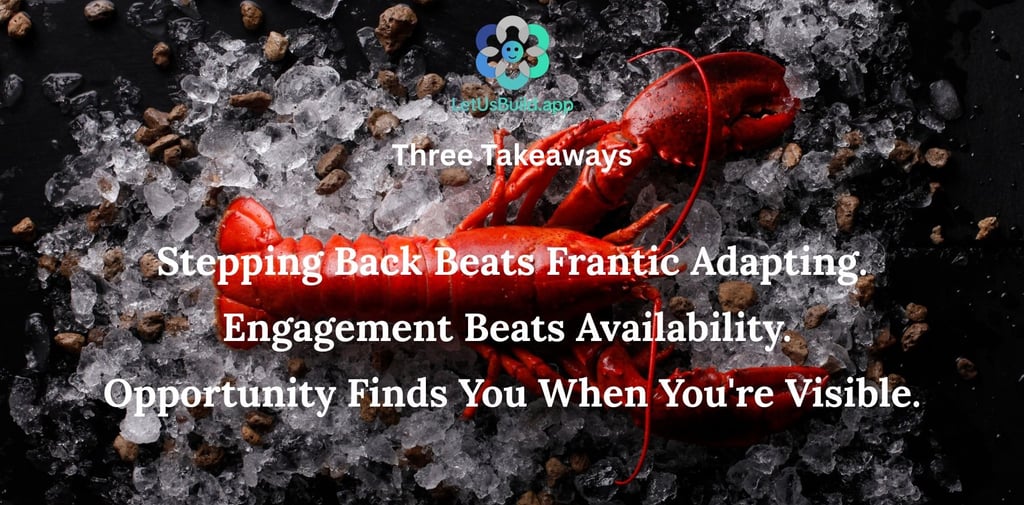
The AI displacement narrative keeps presenting a binary: adapt or obsolete. But Steinberger's path reveals something different. He didn't frantically adapt. He stepped back, reconnected with genuine curiosity, built something he cared about solving, and made himself visible to people solving similar problems.
Then the opportunity came looking.
This isn't guaranteed. But it's far more reliable than the panic-driven alternative. In an AI-transformed economy, the workers who stay employable aren't those who are most desperate to prove their relevance. They're the ones who are so engaged with genuine problems in their domain that they're building solutions, whether or not employment is immediately attached.
The irony is that stepping back—taking time to think, to understand what genuinely fascinates you, to build something meaningful—is often more effective than frantically chasing the next opportunity.
The job that found Steinberger wasn't waiting in a job posting. It emerged from clarity about what he wanted to build and the courage to build it without waiting for permission.
That's the model worth studying if you're displaced or worried about displacement.
"But seek first his kingdom and his righteousness, and all these things will be given to you as well."
Matthew 6:33
Cultivating the Future of Work
Empowering businesses through human-centered AI.
© 2025. All rights reserved.