The Enterprise AI Shift Isn't About Better Vendors—It's About Control
As Mistral races to customise models for enterprises, the real market trend shows companies wanting to build infrastructure they actually own.
TO BUSINESS LEADERS
Kenneth Lam with Claude
3/18/20266 min read
The Chromebook Problem All Over Again
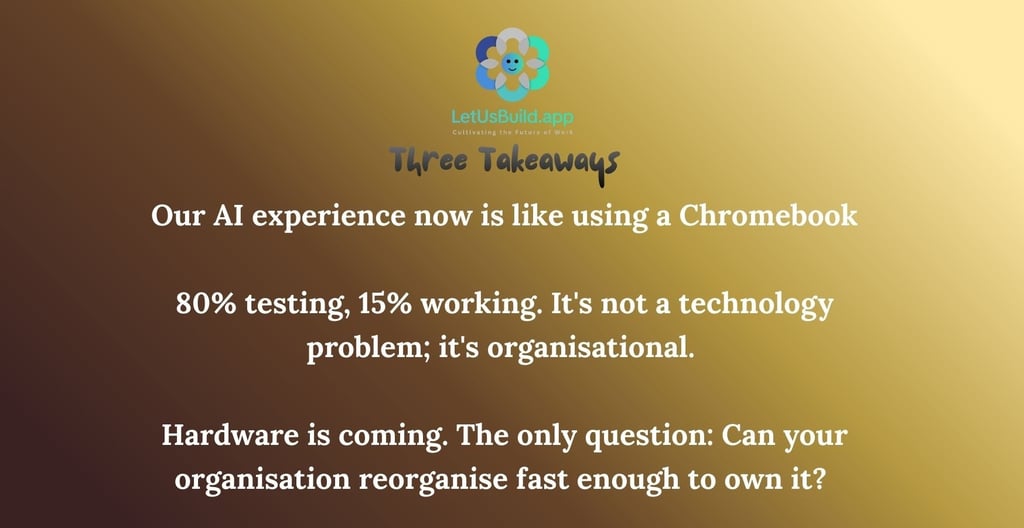
I made a purchase decision six months ago that vindicated an old frustration. I bought a Chromebook to see what everyone had been missing. Years ago, a company I worked for made a bold cost-cutting move: during the laptop replacement cycle, everyone would get Chromebooks instead of traditional laptops. At the time, I thought it was shortsighted. I was right, but not for the reasons I expected.
What I discovered is that a Chromebook isn't really a computer—it's a window into the cloud. Everything meaningful happens somewhere else. Without the internet, it's a brick. Even with good internet, it's slow. Every task has lag. Every response takes time. The friction wasn't obvious until I tried to use it as my main machine and realised how completely dependent it was on internet infrastructure I didn't control.
Now I see the same problem with how we use AI. I use Claude almost daily, and the experience is familiar. I ask a complex question. I watch it think. The words arrive in chunks. There's a wait. I often walk away—grab coffee, check email—and hope the answer is finished by the time I return. The cloud is doing my thinking for me, and I'm waiting for it to finish.
This is the Chromebook problem all over again, but worse. We're not just storing our data in the cloud; we're outsourcing our thinking to someone else's infrastructure. We're accepting the delay, the dependency, the interruption as if it's normal. And for most enterprises, it's becoming a real business problem. Then Apple announced a new generation of laptops that changed the equation entirely.
Mistral's Offer: Build Your Own AI
Before that hardware announcement, Mistral, a French AI company, released news claiming to solve the enterprise version of this problem. They unveiled Mistral Forge, a platform that lets companies build their own AI systems trained on their own data. The logic is simple: most enterprise AI projects fail not because companies lack technology, but because the AI systems they buy don't understand their business. A generic AI trained on the internet can't grasp your specific workflows, terminology, or industry context. Build your own AI instead, trained on your own data, Mistral argues, and you solve the problem.
The problem they're identifying is real. Their diagnosis is accurate. But Mistral is solving yesterday's problem.
Yes, generic AI systems are insufficient for most enterprises. Early companies using Mistral Forge—Ericsson, the European Space Agency, ASML, and Singapore's DSO and HTX—understand this. Their work requires domain expertise that no off-the-shelf system has. Mistral is right that custom matters. But if you watch what's actually happening in the market, a different story is emerging.
But Smart Companies Are Moving Differently
AT&T didn't wait for Mistral Forge. In early 2026, they quietly shifted their customer support away from cloud-based AI services. Instead, they built and deployed smaller, focused AI systems running on their own infrastructure. The result was striking: they cut their monthly AI bills by 90 per cent while making responses 70 per cent faster. They didn't create a new vendor dependency. They reduced vendor dependency entirely.
This shift is accelerating across industries. Seventy-five per cent of IT leaders now report that smaller, focused AI systems outperform the massive general-purpose AI systems for their specific business needs. Enterprise spending on internal AI systems increased 40 per cent in the last year. There's a name for this trend: companies are moving to smaller, targeted systems instead of relying on one giant system. Why? Because they're faster, cheaper, and under the company's control.
The Real Prize: Owning Your Own AI
The deeper insight isn't "you need custom AI." It's "you shouldn't be dependent on any vendor, even vendors offering custom AI." Mistral's solution isn't wrong—but it still leaves you dependent on Mistral. Your data, your AI models, your competitive advantage—all locked into their platform, their roadmap, their decisions about your future.
This is where true competitive advantage lives. But until recently, it wasn't practical. Running AI systems internally meant accepting slow response times, worse accuracy, and choosing between speed and keeping your data private. You had to trade one thing for another. That trade-off just disappeared.
Apple's New Laptops: Finally Fast Enough
Apple released new laptops in March 2026 with significantly improved processing power. These aren't just slightly better—they're fundamentally different. They're built specifically to run AI systems locally, on your device, without needing the cloud. A MacBook Air now starts at $1,099. A MacBook Pro at $2,199. For the first time, your team can have actual AI thinking happening on your own machines.
What this means: You can now run sophisticated AI systems locally at scale. Not as a compromise. Not accepting a slower speed. Not sacrificing privacy. The speed and capability match what you'd get from cloud AI—but it's under your control, on your hardware, with your data staying in your building. Suddenly, the business case for owning your own AI isn't theoretical anymore. It's tangible.
The Catch: Most Companies Aren't Ready Yet
Here's the uncomfortable truth: even though the technology is ready, most enterprises aren't.
Look at what Deloitte found in their 2026 survey of 3,235 enterprise leaders: only 34 per cent are truly transforming their business with AI. The rest are still testing. The biggest barrier? Skills—companies don't have people who understand how to make this work. Nearly a third of organisations are still in testing phases. Over 80 per cent have started AI pilots, but fewer than 15 per cent have turned those pilots into actual working systems that generate real business value.
This gap between testing and actually working is the real story in 2026. It's not a technology problem—the hardware exists, the tools exist, the models exist. The problem is organisational. It's about outdated systems, unclear data, weak processes, and a lack of oversight.
Ninety-five per cent of IT leaders cite integration as a core challenge—meaning their systems don't talk to each other. Seventy-one per cent of business applications don't connect. Only 2 per cent of leaders report successfully connecting even half their applications. These aren't new problems, but AI has exposed them at scale. You can't build internal AI if your data is scattered and unreliable. You can't run AI on your own systems if everything is built for the cloud. You can't take control if your entire infrastructure assumes you'll depend on vendors.
This is why the shift from cloud AI to internal AI isn't happening overnight. It's not a software upgrade. It's rethinking how your entire organisation uses data, technology, and processes—similar in scale to how factories had to redesign everything when they switched from steam power to electricity. Gartner warns that 40 per cent of enterprise AI projects will fail without a real strategy. Most organisations lack the foundational architecture to run AI reliably. They're trying to add AI on top of old systems rather than redesigning everything around AI.
Real competitive advantage doesn't come tomorrow. It requires building from the ground up. Reorganising how data flows. Setting clear oversight. Developing your team's skills. Creating repeatable processes. And managing the change across the organisation. The companies winning fastest aren't the ones with the newest hardware or smartest engineers. They're the ones willing to reorganise their entire business now to own their AI tomorrow.
The Choice: Keep Buying or Start Building
This is the real inflexion point in 2026. It's not about finding the best AI vendor. It's about deciding whether you want your business to depend on vendors for your core AI work. The companies winning aren't looking for the next vendor to hire. They're asking a different question: Why should we depend on anyone when we can build it ourselves?
Your competitive advantage won't come from which AI vendor you choose. It will come from your infrastructure decisions right now. Whether you build or buy. Whether your AI runs on your hardware or someone else's servers. Whether your data stays inside your company or travels to third-party systems.
The choice is no longer theoretical or years away. The technology works today. The math works. The talent exists to execute it. The only question is whether your enterprise is ready to make the changes necessary to own your AI instead of renting it.
"The prudent see danger and take refuge, but the simple keep going and pay the penalty."
Proverbs 27:12
Cultivating the Future of Work
Empowering businesses through human-centered AI.
© 2025. All rights reserved.