The Consultant Dependency: OpenAI's Admission That AI Adoption Needs More Than Code
Why the consulting partnership reveals both the promise and peril in enterprise AI transformation
AI TRENDS
Kenneth Lam
2/25/20264 min read
OpenAI called in the consultants this week. On Monday, the company announced the "Frontier Alliance," multi-year partnerships with Boston Consulting Group, McKinsey, Accenture, and Capgemini designed to accelerate enterprise adoption of OpenAI's technology. On the surface, this looks like a straightforward business move: let specialised intermediaries handle the complicated work of selling to large organisations. But read deeper, and it's an admission that no amount of technical capability can overcome the human reality of organisational transformation.
When Technology Isn't Enough
The consulting partnerships signal OpenAI's recognition of what MIT researchers confirmed last year: 95% of generative AI pilots fail to deliver meaningful business results. For every twenty companies launching AI initiatives, nineteen will struggle to show results that justify the investment. The issue isn't model capability or computational power. Research consistently shows that 70% of AI implementation challenges stem from people and process issues, with only 10% relating to algorithms themselves. Organisations deploy sophisticated tools to employees who fear job displacement, but they lack the strategic clarity and change-management infrastructure to enable adoption. When BCG CEO Christoph Schweizer said that "AI alone does not drive transformation. It must be linked to strategy, built into redesigned processes, and adopted at scale with aligned incentives and culture," he was essentially describing the entire problem that technology alone cannot solve.
This is why consultants matter. The global AI consulting market reached approximately £8.7 billion in 2025 and is forecast to reach £11 billion in 2026, according to Business Research Insights, Future Market Insights, and BCC Research. Organisations recognise they need external expertise to navigate strategy, implementation, and the messy work of changing how people actually work. The consulting partnership model makes sense: these firms bring cross-industry experience, established frameworks, and the objectivity to challenge assumptions that internal teams often cannot. Research from the RAND Corporation shows consultant-led AI implementations succeed at twice the rate of internal builds—67% versus 33%.
The Uncomfortable Truth About the Consultants Themselves
But here's where the story gets uncomfortable. The consulting firms winning these massive contracts are staffed by consultants who are deeply uncertain about their ability to deliver on them.
Recent research from Virtasant reveals that 30% of consultants need formal training to leverage AI tools fully. Another 35% struggle with output validation and verification—meaning they don't trust the AI results they're supposed to be advising clients on. Forty per cent report difficulties integrating AI into existing workflows, which is precisely the integration challenge their clients are hiring them to solve. And perhaps most tellingly, 25% of consultants worry about job security and skill obsolescence. The very people being positioned as AI transformation experts are anxious about being automated away.
This creates a credibility gap at exactly the moment when credibility matters most. Organisations are writing checks for millions of dollars in consulting fees, expecting expertise they can trust. Yet the consultants executing these engagements are, on average, undertrained and uncertain. The consulting industry is also experiencing "AI fatigue"—consultants burning out under pressure to rapidly build capabilities they don't yet possess.
The Pipeline Problem Nobody's Discussing
There's also a structural problem emerging. With AI automating routine analytical tasks, there's less need for large teams of junior consultants. Historically, consulting firms built their pipeline by hiring bright graduates, having them grind through predictable analytical work for three to five years, then promoting the best into leadership roles. That model is collapsing. When AI handles the work junior consultants used to do, where does the next generation of senior consultants come from?
A Forcing Function for Industry Maturity
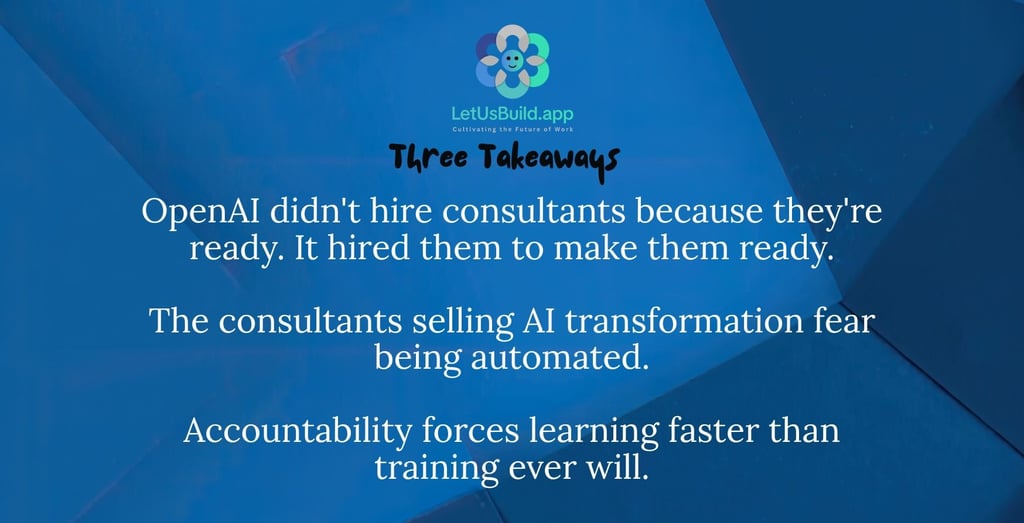
Yet there's a counter-narrative worth considering. OpenAI's strategy may not be naive about these gaps—it may actually be banking on them. By tying massive consulting partnerships directly to real client implementations, OpenAI is creating what might be called a "forcing function" for consultant development. The firms win these contracts precisely when they're least ready. But being forced to deliver, at scale, to demanding enterprise clients creates pressure that structured training programs rarely achieve.
This isn't comfortable. Consultants will struggle. Projects will take longer than expected. Some implementations will fail despite consultant efforts. But there's historical precedent: when large professional services firms faced previous technology transitions—cloud computing, digital transformation, big data—they didn't have mature expertise sitting on the shelf. They built capability through intense, high-stakes client work. The pattern: early engagements are rough, but the learning compounds rapidly. Consultants who survive the initial gauntlet become genuinely expert. The market matures through productive struggle.
What's happening now is similar. OpenAI isn't waiting for consultants to get ready. It's making consultant readiness a business condition. The partnerships create accountability. If BCG says they can deliver AI transformation, they now have to prove it with real clients, real stakes, and real consequences. That pressure, while painful, is often what's required for an industry to actually evolve.
The Paradox at the Heart of This Strategy
The paradox remains sharp: consulting firms are winning contracts to manage AI transformation precisely because AI transformation is too complex and human-centred for pure technology to handle. Yet the firms winning those contracts are staffed by people who haven't fully internalised AI capabilities themselves. They're racing to build expertise faster than the market is demanding it, while trying to deliver implementations to equally unprepared clients.
But that racing, that struggle, that pressure to learn under real conditions—that's how industries actually mature. OpenAI's consulting partnerships aren't a bet that consultants are ready. They're a bet that consultants will become ready, fast enough, under pressure. That's still a gamble. But it may be the only way the market actually moves from pilot purgatory to genuine, scalable enterprise adoption.
"And the things you have heard me say in the presence of many witnesses entrust to reliable people who will also be qualified to teach others."
2 Timothy 2:2
Cultivating the Future of Work
Empowering businesses through human-centered AI.
© 2025. All rights reserved.