
The Adoption Illusion: Why Having AI Tools Isn't the Same as Implementing AI
Singapore ranks #2 globally in AI adoption—yet struggles with transformation. New research reveals where organizations are getting stuck, and why HR is the answer.
TO HR PROFESSIONALS
Kenneth Lam
2/20/20263 min read
Singapore ranks #2 globally in AI adoption—yet struggles with transformation. New research reveals where organizations are getting stuck, and why HR is the answer.
When Billions in Investment Deliver Nothing
Walk into boardrooms across Singapore, and you'll hear the same frustrated conversations. Companies invested heavily in AI tools. They rolled out implementations. Yet productivity remains flat. Customer satisfaction hasn't moved. Employee engagement has actually declined. Someone is inevitably asking: "We bought the best tools. We followed the vendor playbooks. So why aren't we seeing the results we were promised?"
A major global survey published this week provides the sobering answer. The National Bureau of Economic Research study, examining responses from approximately 6,000 CEOs, CFOs, and senior leaders across the United States, United Kingdom, Germany, and Australia, reveals that 89 percent of firms report no meaningful productivity impact from AI over the past three years. Perhaps more telling: 60 percent expect zero additional impact going forward. Companies haven't abandoned these tools—69 percent of firms now use AI. But they're also not seeing the transformation they expected.
This isn't a technology failure. It's an organizational failure. And it's preventable.
The Singapore Mirror
Singapore's latest policy moves suggest the government understands something many organizations still miss. On February 12, Prime Minister Lawrence Wong announced the establishment of a National AI Council, which he will chair personally. But the real insight came in what Wong said about why most firms struggle.
"Many firms say they are using AI. But end-to-end transformation is demanding. It requires organising data, rebuilding systems, redesigning processes and jobs, and retraining workers. Even major global companies are grappling with this."
This is not the language of technology procurement. This is the language of organizational transformation. And it's precisely what most companies have failed to do.
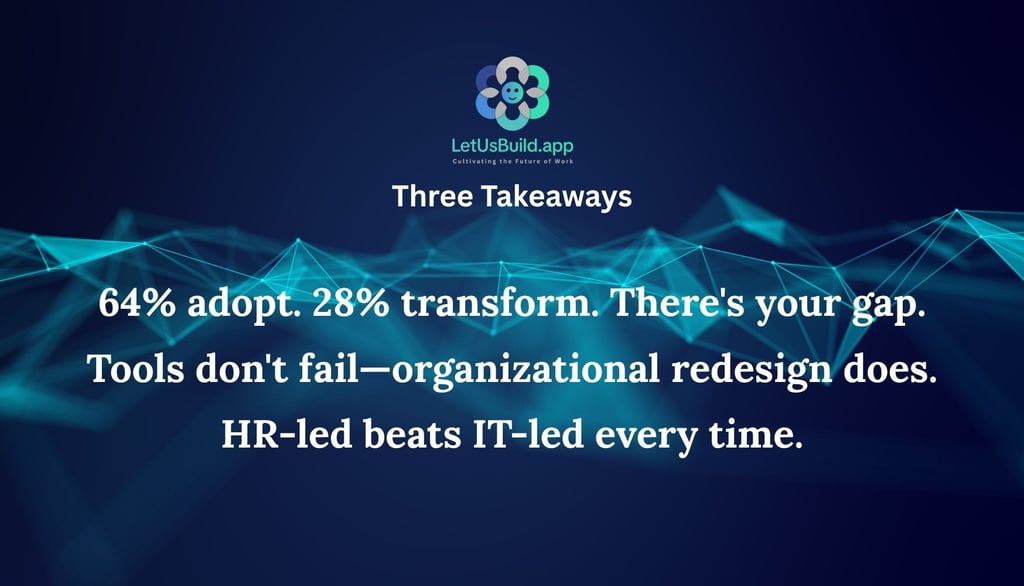
Consider Singapore's position in the global AI landscape. According to Microsoft's AI Economy Institute data, Singapore ranks #2 globally in working-age population adoption of AI tools, with 64 percent engagement. Yet Deloitte's recent Singapore-specific research reveals that only 28 percent of Singapore businesses are using AI to fundamentally reinvent their core processes and business models. Nearly two-thirds remain focused on basic automation—using AI tools without redesigning how work actually happens. The adoption-to-transformation ratio mirrors the global picture: widespread tool deployment, minimal organizational change.
Where the Real Problem Lives
The gap between adoption and transformation isn't mysterious. It's the direct result of treating AI implementation as a technology project rather than an organizational transformation initiative.
When IT departments lead AI implementation, they naturally focus on system integration, data architecture, and tool deployment. These are legitimate concerns. But they miss the human reality that determines whether implementation succeeds or fails. Employees don't resist AI because they struggle with technology. They resist because they fear displacement, skill obsolescence, or unclear career pathways in AI-augmented roles. Managers avoid conversations about job redesign, hoping that productivity improvements will somehow resolve themselves without difficult organizational decisions. Leadership becomes fascinated by AI capabilities without clearly defining which business problems need solving or what organizational changes are necessary.
The result is predictable. Sophisticated tools deployed to uncertain, anxious employees who provide minimal engagement. The technology works perfectly in isolation but fails catastrophically in human environments.
Why Singapore's AI Council Matters More Than Technology
The government's new Champions of AI program explicitly focuses on comprehensive business transformation including workforce training and job redesign. This represents a fundamental acknowledgment that technology implementation fails without organizational capability building. The Council itself comprises not just tech ministers but the Minister for Manpower, reflecting recognition that this is fundamentally a people challenge.
This is what HR-led implementation looks like at scale. Instead of asking "What AI tools can we buy?" the question becomes "How do we redesign roles, develop capabilities, and prepare our workforce for AI-augmented work?" Instead of treating job redesign as an afterthought, it becomes central to strategy.
The Path Forward
Organizations that succeed with AI do something fundamentally different from those that struggle. They make HR leadership central to implementation strategy, not peripheral to it. They invest 70 percent of AI resources in people and process transformation, not technology. They redesign jobs around human-AI collaboration rather than expecting employees to adapt to tool-centric workflows.
The TechRadar survey shows what happens when you get this wrong. Singapore's new policy framework suggests what getting it right looks like. For organizations in Singapore and beyond, the choice is becoming clear. Adopt AI as a technology project and join the 89 percent seeing minimal impact. Or recognize AI transformation as an organizational challenge requiring HR leadership, comprehensive job redesign, and sustained capability development.
The tools alone will never be enough. But the people—properly supported, strategically deployed, and genuinely developed—can make all the difference.
"And the things you have heard me say in the presence of many witnesses entrust to reliable people who will also be qualified to teach others."
2 Timothy 2:2
Cultivating the Future of Work
Empowering businesses through human-centered AI.
© 2025. All rights reserved.