
Claude's Outages Show the Dark Side of AI Productivity: Total System Collapse
When the tool that replaced your thinking fails, you realise you can't think anymore.
AI FAILURES
Kenneth & Claude
3/9/20264 min read
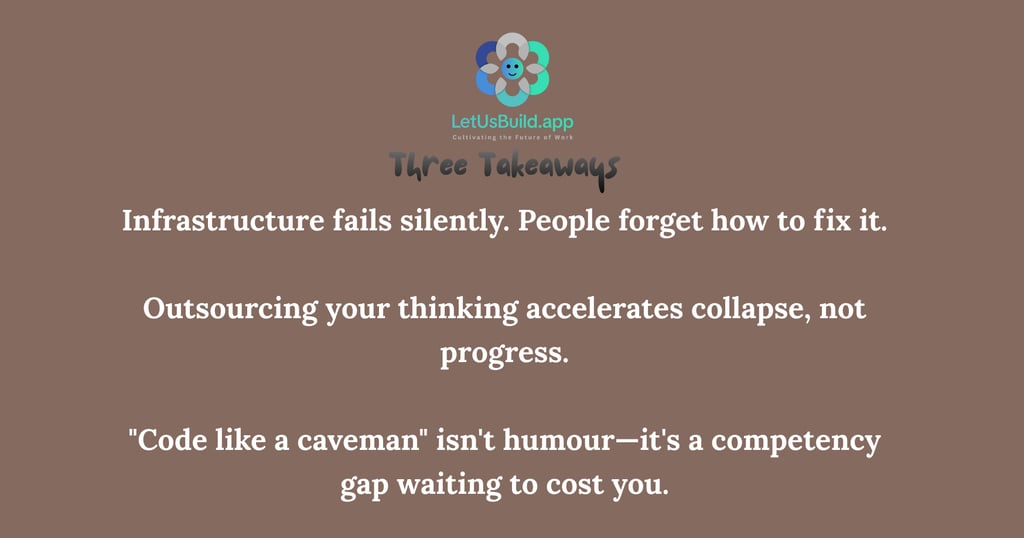
When Anthropic's Claude AI stopped working last week, something unexpected happened. Developers didn't pivot to other tools. They didn't switch to alternative models. They stopped working entirely. A senior engineer at Meta told Business Insider that tools like Claude have become so embedded in daily workflows that when Claude went down, he turned his attention to non-coding tasks. He believed it might be slower to tackle coding manually. One Reddit user captured the darkest humour: "I guess I'll write code like a caveman." Another posted: "Claude outages hit way harder when you realise you've outsourced half your brain to it."
This wasn't a minor inconvenience. The outages lasted hours across both Claude.ai and Claude Code. Anthropic's head of Claude Code attributed the disruption to "rapid user growth straining our services." But that explanation misses the deeper story. The outages revealed something systemic: we've built an entire development infrastructure on a single cloud-hosted tool, and simultaneously, we've stopped developing the foundational skills needed to survive without it.
The immediate reaction from the developer community was telling. Don't panic about lost work. Not frustrated about delays. Instead, a recognition that the muscle memory for independent coding had atrophied. This week's disruption wasn't just a service failure. It was a window into how fragile our current approach to AI adoption really is.
The Infrastructure Fragility Nobody Wants to Acknowledge
2025 was defined by cascading failures across cloud infrastructure. AWS suffered a major regional outage lasting over 15 hours. Cloudflare's maintenance misconfiguration triggered widespread edge network failures affecting billions of users. Google Cloud's authentication systems faltered. Azure's global routing issues took down services even though backend systems were technically healthy. These incidents didn't happen in isolation. They revealed a pattern.
The problem is structural. AI workloads generate traffic patterns fundamentally different from human-scale usage. According to infrastructure analysis from Data Centre Knowledge, AI systems create continuous, high-velocity, parallel requests that test every dependency in ways traditional applications never did. When one layer fails—whether it's authentication, routing, or edge infrastructure—the failure cascades upward with wider blast radii and faster propagation. Small configuration errors that would have caused isolated incidents now trigger global outages.
The data backs this up. A Cockroach Labs survey found that 77% of senior technology executives expect AI to drive at least 10% of all service disruptions in 2026. Nearly a third identify the database as a critical point of failure. More troubling: 93% of executives worry about downtime's impact on their business, yet organisations continue building increasingly AI-dependent workflows without maintaining redundancy or recovery capability.
This is the first vulnerability: infrastructure built for speed, not resilience.
The Skills We're Losing While We Celebrate Productivity
The second vulnerability runs deeper. While developers celebrated how Claude accelerated their work, something else was happening. They stopped building foundational coding knowledge.
Gartner's analysis predicts that atrophy of critical-thinking skills due to GenAI use will push 50% of organisations to require "AI-free" skills assessments by 2026. This isn't hyperbole. According to research from Stack Overflow, overreliance on AI eliminates the discovery phase of learning—that precious, priceless part where you root around blindly until you finally understand. Junior developers entering the workforce have never had that experience. They've never had to struggle through a problem because Claude solved it on the first try.
The employment data is stark. A Stanford Digital Economy Study analysed payroll records showing that employment for software developers aged 22-25 declined nearly 20% from its peak in late 2022, while employment for developers 30 and older actually grew. The pattern is clear: AI is absorbing the textbook knowledge that entry-level workers rely on. It's also absorbing the very work experience they need to develop deeper competency.
This creates a secondary crisis. Entry-level job postings have declined by approximately 35% since January 2023. The traditional pathway—get educated, land an entry-level role, learn on the job—is collapsing. Organisations face a talent pipeline crisis that they haven't adequately acknowledged.
This is the second vulnerability: human capability eroding while we celebrate machine capability.
When Both Vulnerabilities Collide
Here's what last week's outages exposed: the two vulnerabilities aren't separate problems. They're the same problem viewed from different angles.
When Claude went down, developers couldn't work because they'd outsourced their thinking to it. But more critically, even if they wanted to troubleshoot what went wrong with Claude itself—to understand the infrastructure failure—they likely lacked the foundational knowledge. The system was fragile, and the people who should have been able to repair it had lost the skills to do so.
This is the seductive trap of AI productivity. It doesn't just speed up work. It creates a false sense of control. Organisations believe they're gaining efficiency, but they're actually increasing systemic risk. Every efficiency gain comes at the cost of redundancy, backup capability, and human understanding.
What Actually Matters
The issue isn't whether organisations should use Claude or reject AI tools. They should use them. The issue is that the current implementation patterns treat AI as a replacement for foundational capabilities rather than an enhancement of them.
Organisations need to maintain—actively, deliberately—the ability to function without these tools. Not as a theoretical exercise, but as a core operational requirement. This means investing in junior developer training that doesn't rely on AI. It means building systems with resilience and redundancy. It means asking harder questions about what happens when infrastructure fails.
The developers who said they'd "code like cavemen" this week weren't joking. They were describing an actual competency gap. And next time Claude goes down—and it will—that gap will determine whether your organisation pauses or adapts.
The most dangerous productivity gains are the ones that erode your ability to recover from failure. Last week's outages proved we've been optimising for the wrong metric: speed over resilience, automation over understanding, tools over capability.
That's not the dark side of AI productivity. That's the cost of building infrastructure and capabilities without considering what happens when they break.
"The prudent see danger and take refuge, but the simple keep going and pay the penalty."
Proverbs 22:3
Cultivating the Future of Work
Empowering businesses through human-centered AI.
© 2025. All rights reserved.